

February 2024 • Event
NSDF All Hands Meeting 2024
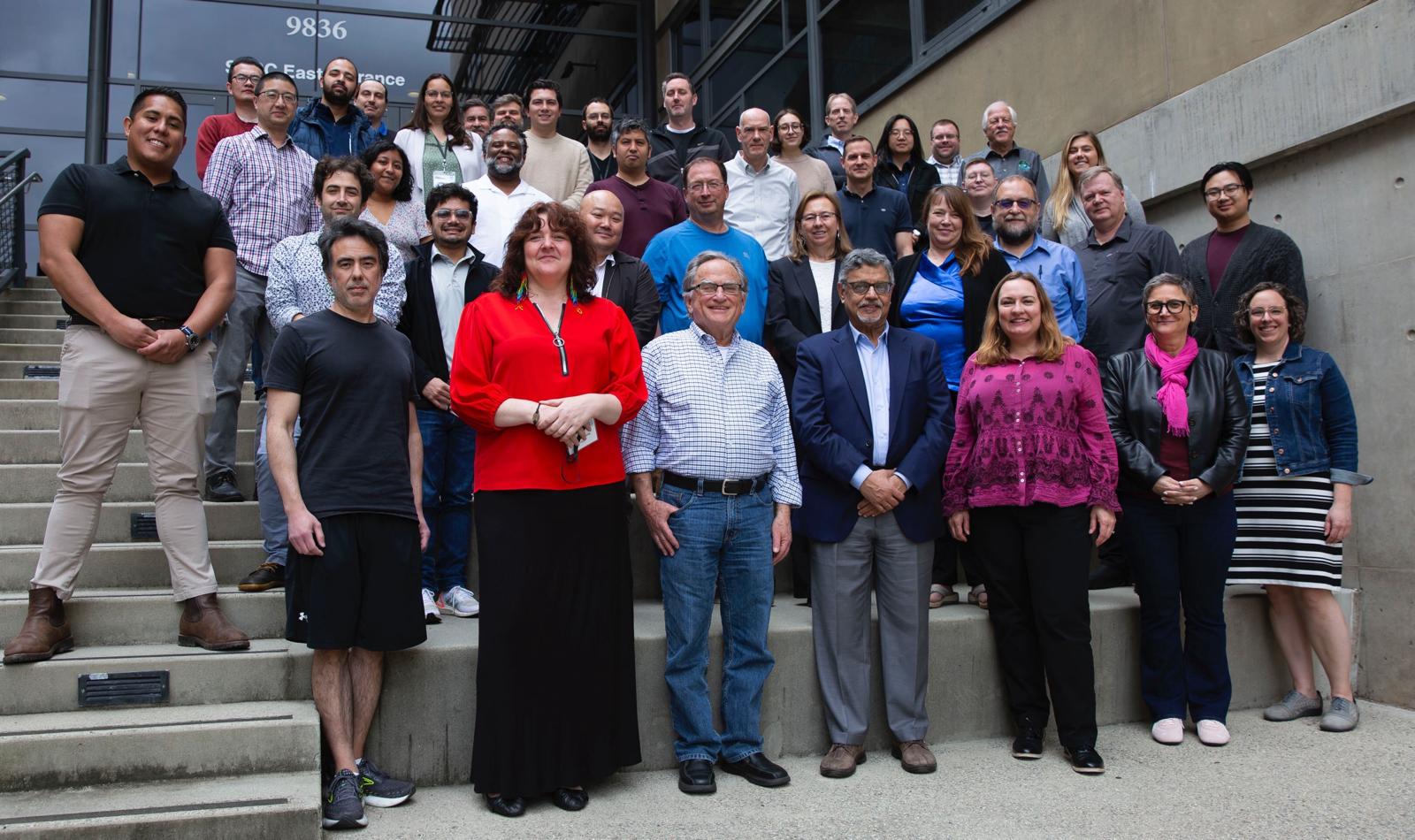
The fourth National Science Data Fabric (NSDF) in-person meeting was held at the San Diego Supercomputer Center in La Jolla, California on February 28–March 1, 2024.
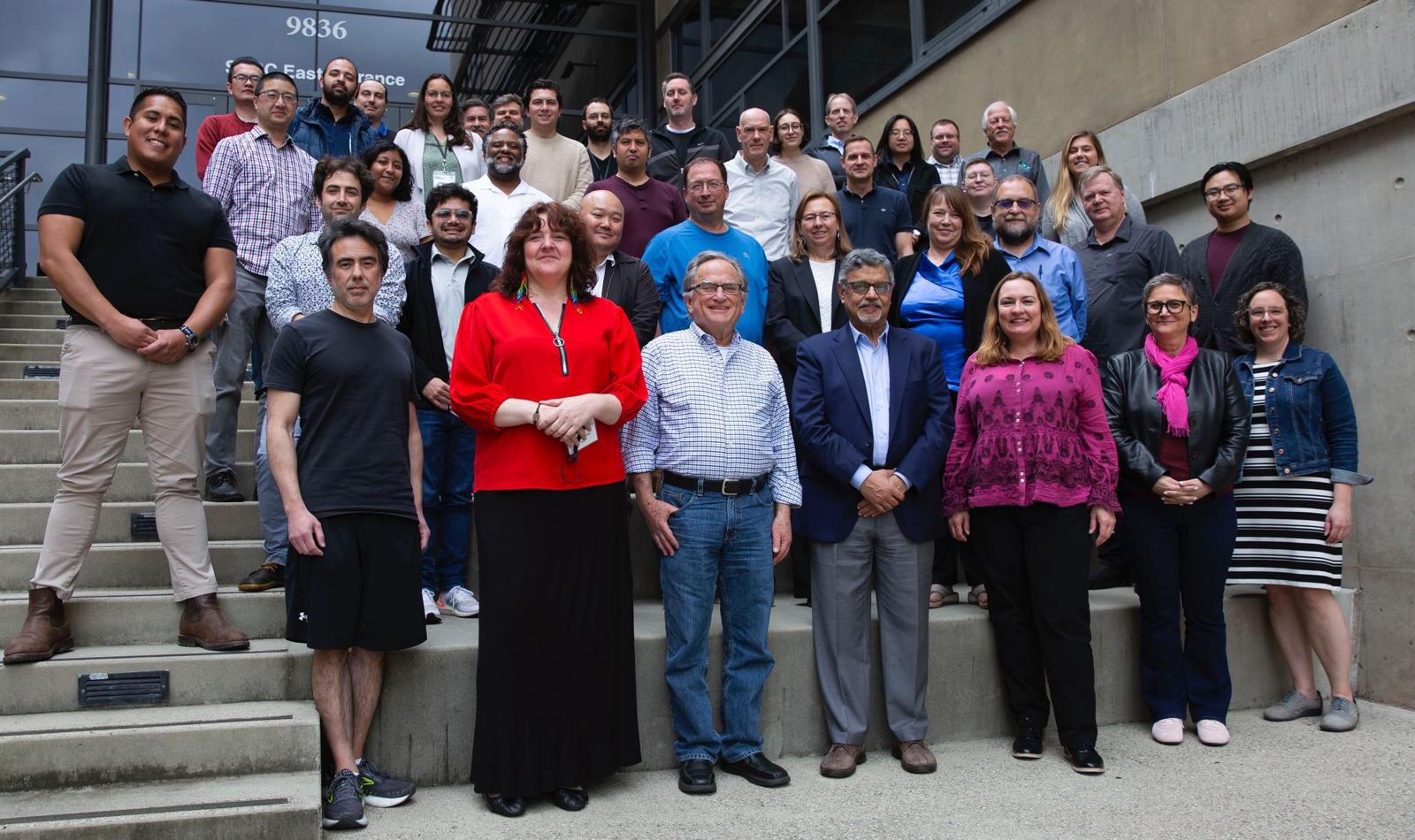
Keynote: Chaitan Baru
Keynote Speaker: Chaitan Baru, Senior Advisor, TIP Directorate, NSF
Title: The Prototype Open Knowledge Network (Proto-OKN) Fabric

Abstract
In September 2023, NSF announced an investment of $26.7 million in 18 projects for its Building the Prototype Open Knowledge Network (Proto-OKN) program, in collaboration with five other U.S. government agencies. The 18 funded projects are expected to work together over the next 3 years, as a single cohort to create an open knowledge network that is a publicly accessible, interconnected set of data repositories and associated knowledge graphs that will enable data-driven, artificial intelligence-based solutions for a broad set of societal and economic challenges.
NASA, NIH, the National Institute of Justice, NOAA and the U.S. Geological Survey are partnering with NSF on this effort, along with an additional 15 U.S. federal and state agencies that are working closely with the awardees to ensure that Proto-OKN supports each agency’s data strategy while addressing use cases associated with agency data. Of the 18 projects, 15 are focusing on use cases representing agency applications, two projects are focusing on creating the Proto-OKN Fabric to provide the technological platform, and one project is providing education and training materials and coordination across the entire effort.
This talk will describe the concepts, ideas, and technologies in the emerging Proto-OKN Fabric. For project focusing on data cyberinfrastructure, the identification and pursuit of sustainability strategies and an engaged, early user/customer base, is even more essential than the technological concepts and infrastructure. The Proto-OKN initiative constitutes an investment by the TIP Directorate to advance key technologies—data and AI, in this case—while addressing pressing national, societal and geostrategic challenges, as authorized by the CHIPS and Science Act of 2022.
Bio
Chaitan Baru is a Senior Advisor in NSF’s new Technology, Innovation, and Partnerships (TIP) Directorate where he assists with strategy and ideation of new programs. He first joined NSF in 2014, as Senior Advisor for Data Science in the CISE Directorate where he co-chaired the NSF Harnessing the Data Revolution (HDR) Big Idea and led the BIGDATA program. He returned to NSF in 2019 as Senior Advisor for the NSF Convergence Accelerator and as a member of the team that launched the program. Prior to joining NSF in 2022, Chaitan had a 25-year career at the San Diego Supercomputer Center, University of California San Diego.
Keynote: Sandra Gesing
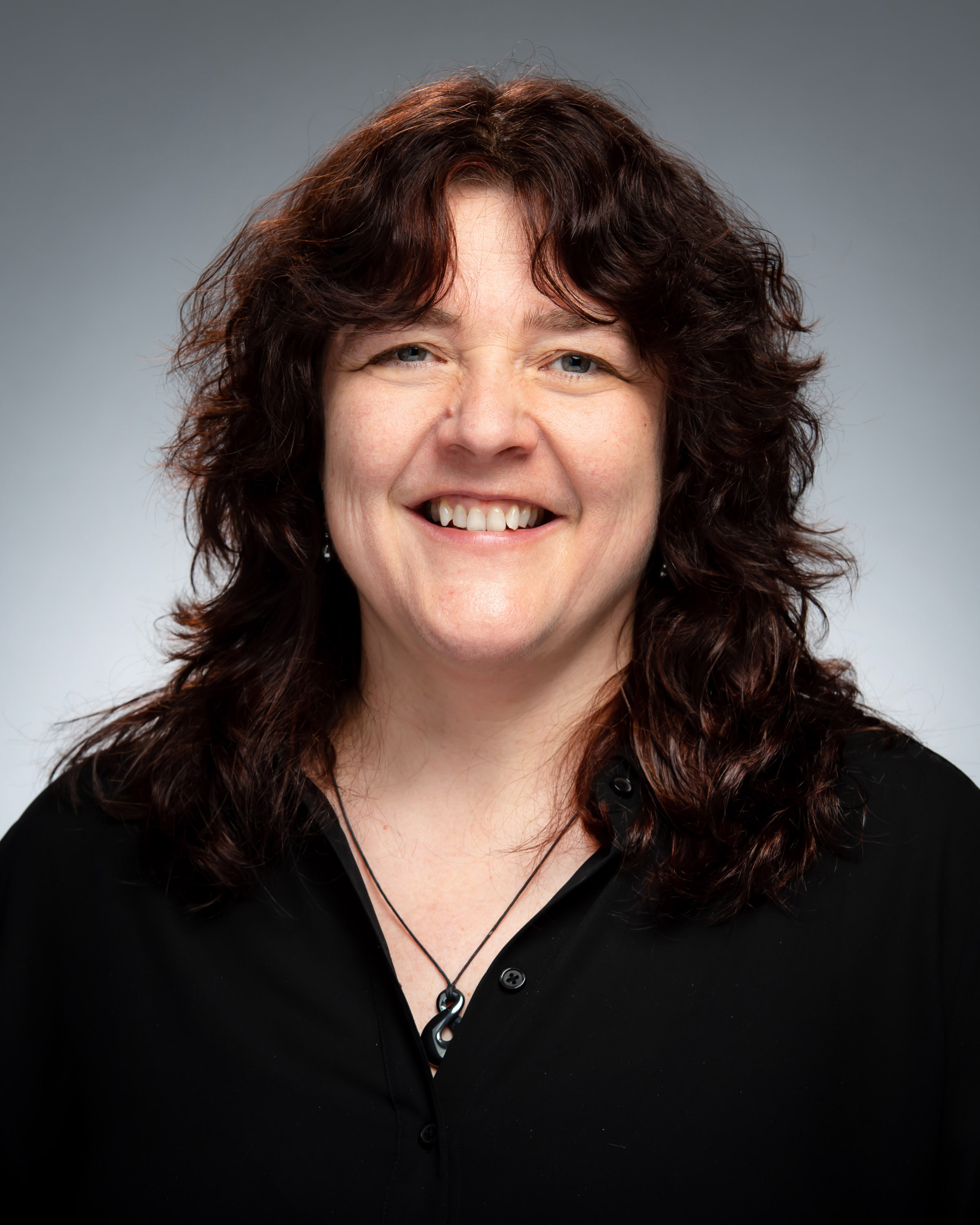
Keynote Speaker: Sandra Gesing, Senior Researcher at the San Diego Supercomputer Center, Executive Director of the US Research Software Engineer Association (US-RSE)
Title: Ushering in a New Era with Unconventional Paths and Hidden Contributors Driving Discoveries in Academia and National Labs
Abstract
Over the past decade, academia and national labs have increasingly recognized the crucial role of hidden contributors contributing to accelerating science. The acknowledgement is evident in quite some projects. From the founding of 8 Research Software Engineer Associations worldwide to the dedicated efforts of the Campus Champions and the NSF Center of Excellence for Science Gateways. While it is encouraging that the importance of cyberinfrastructure and research software and the people being in this line of work receive more attention, we still have a long road in front of us for well-defined career paths and incentives.
A multi-facet approach is needed to meet researchers and educators as well as the hidden contributors where they are. This keynote will delve into the crucial role of research software engineers, science gateway creators, and research facilitators in advancing research and computational activities. Furthermore, it will highlight the importance of fostering a community that encompasses all stakeholders in academia and national labs, advocating for a cultural change and actionable measures on how everyone can contribute to make it happen.
Bio
Sandra Gesing is the inaugural Executive Director of the US Research Software Engineer Association and a Senior Researcher at the San Diego Supercomputer Center. Her research focuses on science gateways, computational workflows as well as distributed and parallel computing. She is especially interested in sustainability of research software, usability of computational methods and reproducibility of research results. Sustainability of research software has many facets and she advocates for improving career paths for research software engineers and facilitators and for incentivizing their work via means beyond the traditional academic rewarding system.
Before her positions at US-RSE and SDSC, she was a senior research scientist at the Discovery Partners Institute (DPI), University of Illinois System, Chicago and she was an associate research professor at the University of Notre Dame, Indiana, US. Before she moved to the US, she was a research associate at the University of Edinburgh, UK, and at the University of Tübingen, Germany. Additionally, she has perennial experience as a project manager and system developer in industry in the US and Germany. She received her Master’s degree in computer science from extramural studies at the FernUniversität Hagen and her PhD in computer science from the University of Tübingen, Germany.
Schedule
You can find the program PDF here.
Wednesday, February 28
Session 1 — Welcome, Vision, and Introduction (Chair: Michela Taufer)
| Affiliation | Speaker | Title | Slides |
|---|---|---|---|
| UTK | Michela Taufer | An Introduction to the National Science Data Fabric — DOI | 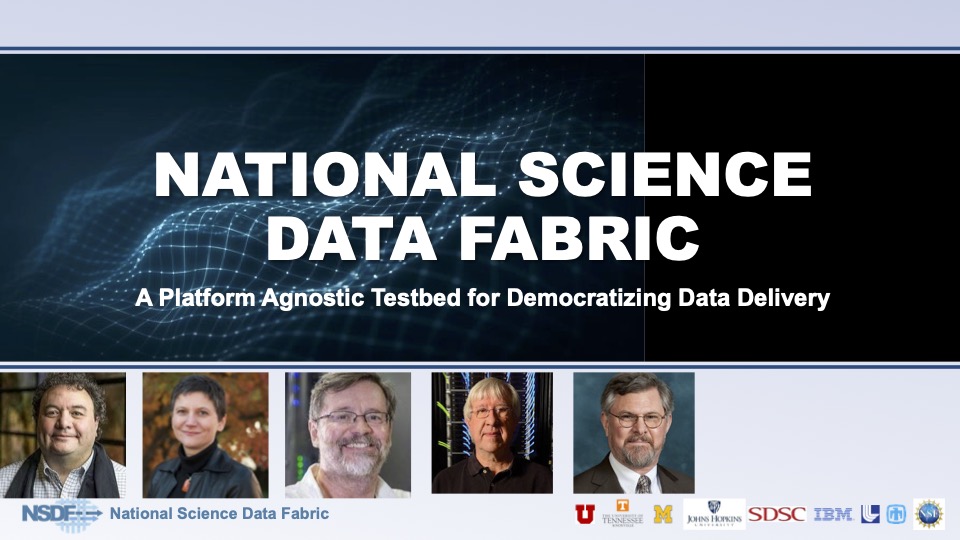 |
Session 2 — NSDF Tutorial (Chair: Attila Gyulassy)
| Affiliation | Speaker | Title | Slides |
|---|---|---|---|
| UTK / Utah | Heberth Martinez, Aashish Panta, Michela Taufer | Tutorial: Using NSDF for End-to-End Analysis of Scientific Data — DOI | 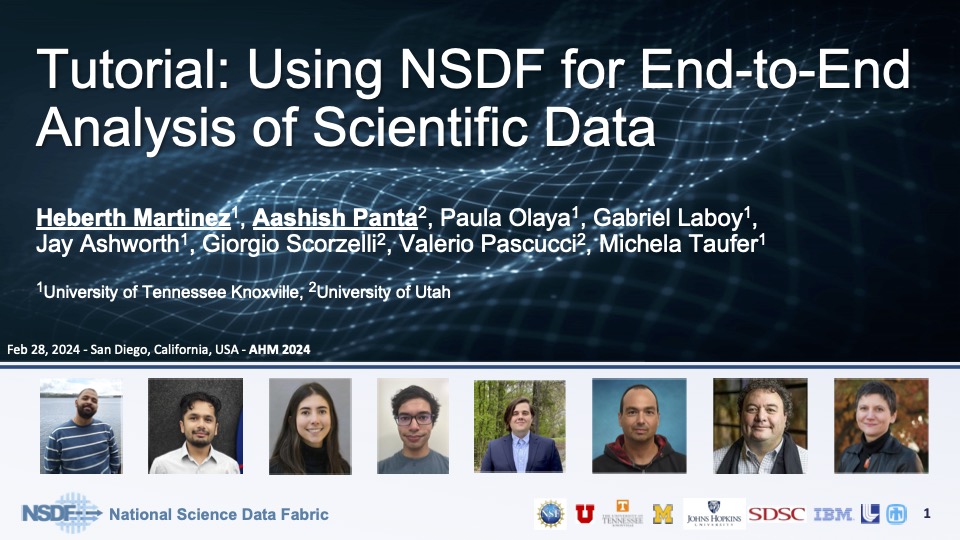 |
Session 3 — Platforms and Architectures
| Affiliation | Speaker | Title | Slides |
|---|---|---|---|
| Globus | Kyle Chard | Globus Platform as a Service — DOI |  |
| Voltron | Fernanda Foertter | Decomposing Data Systems for Better Performance — DOI |  |
| NCSA | Kenton McHenry | Democratized Data Discovery and Access: Helping Communities and Repositories Adopt Science on Schema — DOI |  |
| Ronin | Doug Fils | Building Blocks of Integration: An Exploration of CODATA CDIF Goals with NSDF Architecture — DOI |  |
Thursday, February 29
Session 4 — Data Distribution and Infrastructure (Chair: Christine Kirkpatrick)
| Affiliation | Speaker | Title | Slides |
|---|---|---|---|
| SDSC | Marty Kandes | Near-Field and Far-Field Data Distribution for ICICLE: Intelligent CyberInfrastructure with Computational Learning in the Environment — DOI |  |
| HDSI/UCSD | Arum Kumar | HDSI DataPlanet: Spurring Data-Intensive Collaborations — DOI |  |
| Utah State U | Steve Petruzza | Multi-layer Caching and Parallel Streaming for Large Scale Point Cloud Data on the Web — DOI | 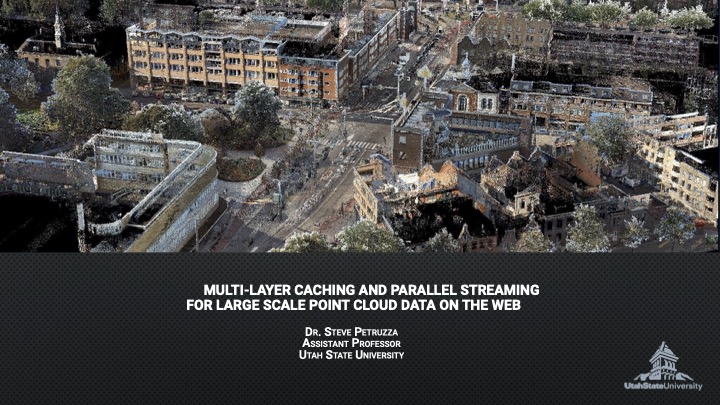 |
| ORNL | Olga Kuchar | Data Lifecycle Technologies at Oak Ridge Leadership Computing — DOI |  |
| U Wisconsin Madison | Miron Livny | An Overview of Pelican, OSDF, and OSPool — DOI |  |
Session 5 — Keynote: Chaitan Baru (Chair: Michela Taufer)
| Affiliation | Speaker | Title | Slides |
|---|---|---|---|
| NSF | Chaitan Baru | Keynote: The Prototype Open Knowledge Network (Proto-OKN) Fabric — DOI |  |
Session 6 — Storage and Data Management (Chair: Steve Petruzza)
| Affiliation | Speaker | Title | Slides |
|---|---|---|---|
| Seal Storage | Scott Doughman and Sal Malik | Large Research Data Storage on Blockchain Technology — DOI |  |
| HDF | Scot Breitenfeld | The HDF5 Framework: Practical Tools for Managing Data — DOI | 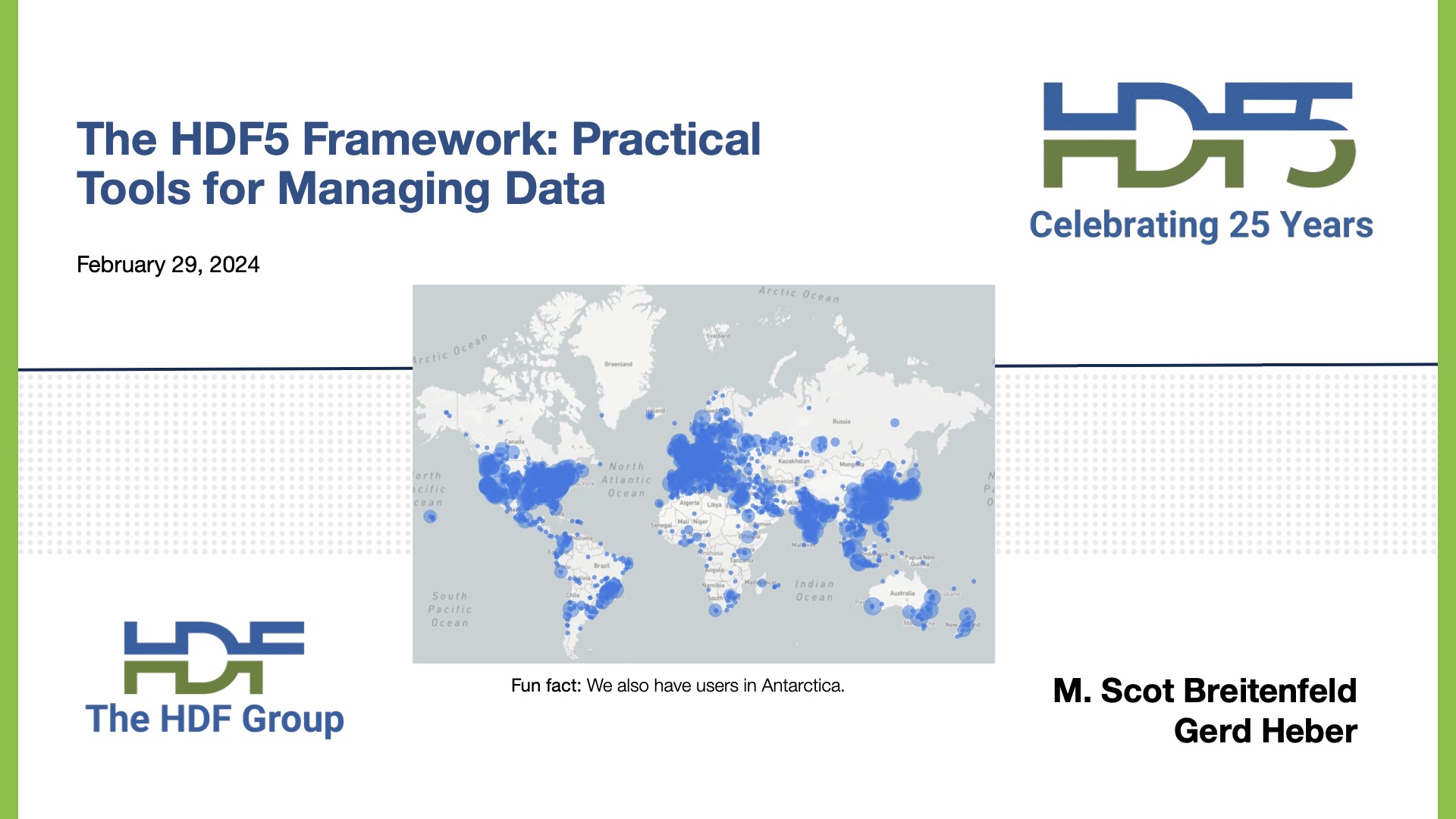 |
| ViSOAR | Amy Gooch | VisStore: Seamless Acquisition, Storage, and Distribution of Massive Imagery blending Cloud, Local and HPC Storage — DOI | 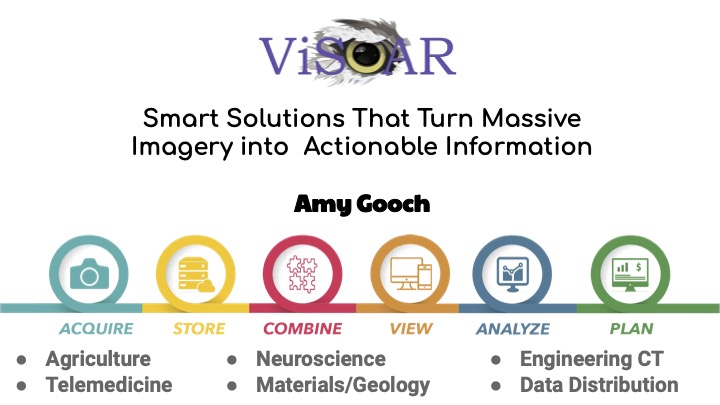 |
| SDSC | Fabio Andrijauskas | Monitoring the Open Science Data Federation — DOI |  |
| ICSI / LBNL / UC Berkeley | Michael Mahoney | Open Data, Large-Scale Compute, and Scientific Foundation Models — DOI |  |
Session 7 — Community and Applications (Chair: Amy Gooch)
| Affiliation | Speaker | Title | Slides |
|---|---|---|---|
| CHESS | Werner Sun | Visualizing CHESS Data with NSDF Dashboards — DOI |  |
| Windows on Earth | Dan Barstow | Sally Ride Windows on Earth — DOI | 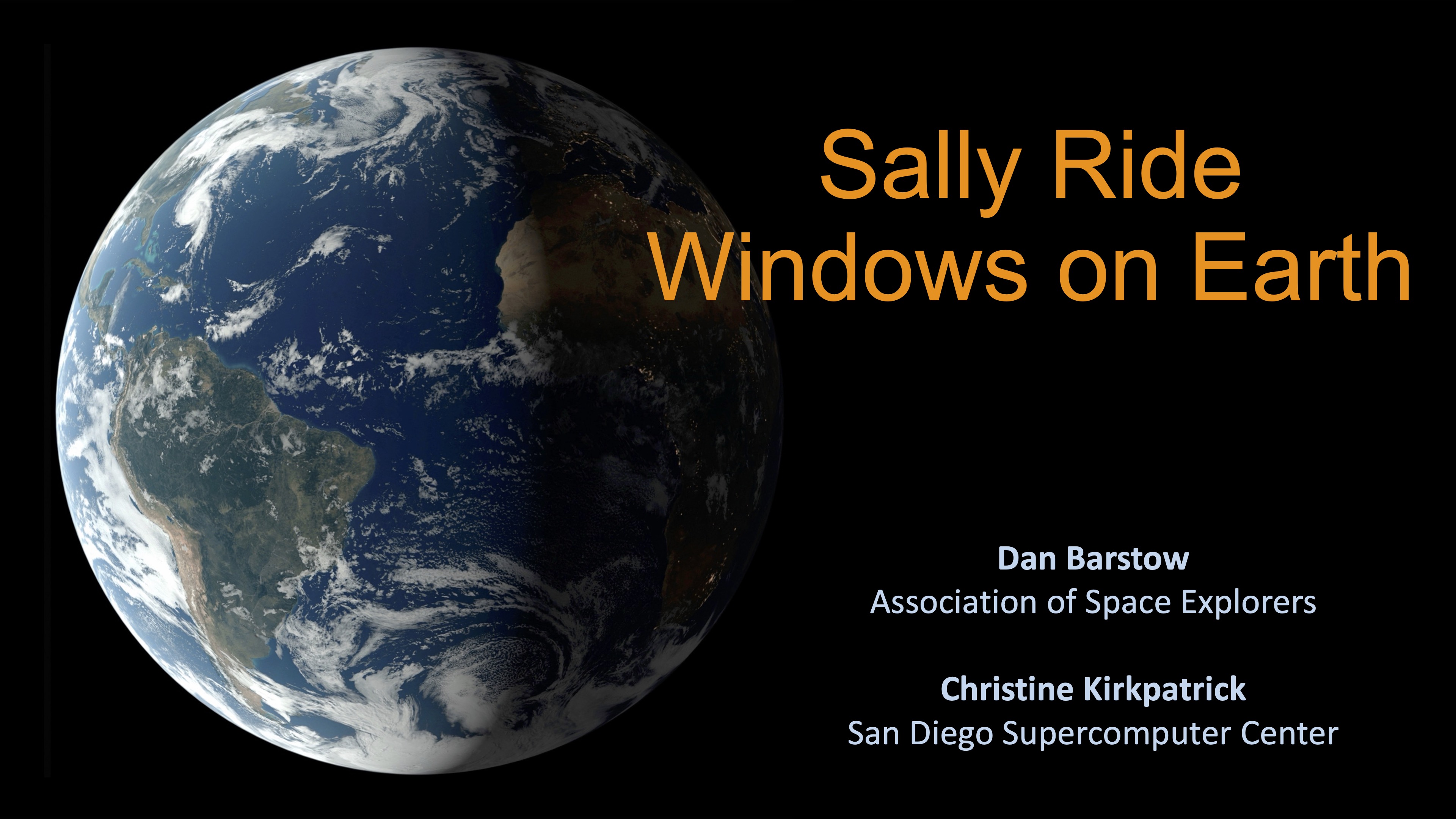 |
| U Colorado Denver | Amy Roberts | Sharing Data across Deep Underground Experiments — DOI |  |
| UTEP | Erwin Cazares | Applications of Deep Learning for Fragment Size Analysis |
Friday, March 1
Session 8 — Keynote: Sandra Gesing (Chair: Michela Taufer)
| Affiliation | Speaker | Title | Slides |
|---|---|---|---|
| SDSC | Sandra Gesing | Keynote: Ushering in a New Era with Unconventional Paths and Hidden Contributors Driving Discoveries in Academia and National Labs — DOI |  |
Session 9 — Community, Policy, and Future Directions (Chair: Lauren Whitnah)
| Affiliation | Speaker | Title | Slides |
|---|---|---|---|
| Texas Tech U / CI Compass | Kerk Kee | Technology Adoption Research and the Cyberinfrastructure Community — DOI |  |
| SDSC | Ilkay Altintas | National Data Platform: Data and AI Services for All — DOI |  |
| Dillard U | Dennis Sigur | Opportunities and Challenges at HBCUs — DOI |  |
| Utah State U | Gustavo Ovando-Montejo | Democratizing Spatial Data for Climate Change Risk Assessment across Native American Nations — DOI |  |
| Utah / UTK / SDSC | Attila Gyulassy | A Report on New Directions in User Community Interviews — DOI | 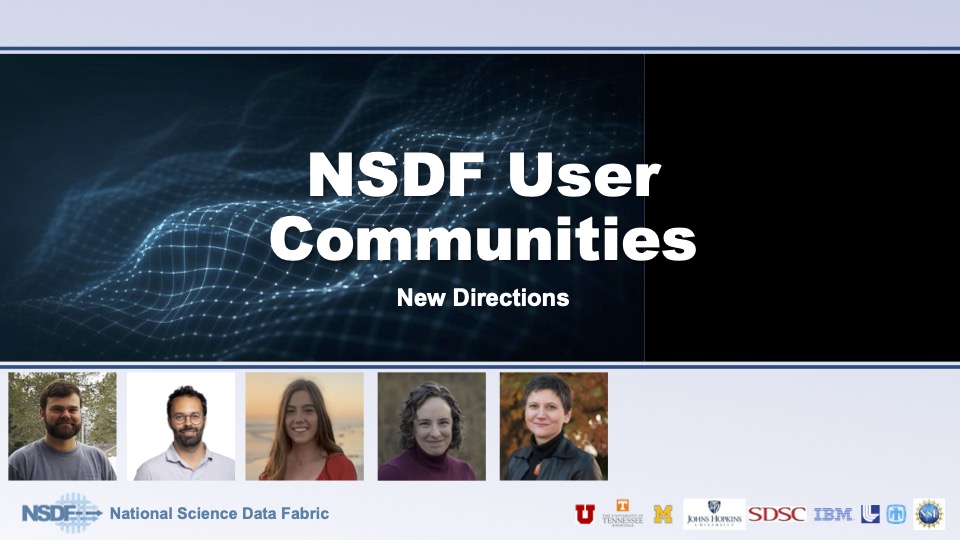 |
Hotels
The meeting hotels include:
-
La Jolla Shores Hotel — 8110 Camino Del Oro, La Jolla, CA 92037 — (855) 923-8058 A limited number of rooms at a discounted rate of $269 per night were available until February 9, 2024.
-
The Residence Inn — 8901 Gilman Drive, La Jolla, CA 92037 — (858) 587-1770 / (800) 331-3131 Rates: $264–$460 per night
-
Sheraton La Jolla Hotel, Torrey Pines — 3299 Holiday Ct., La Jolla, CA 92037 — (858) 453-5500 / (800) 345-9995 Rates: $268–$412 per night
Venue
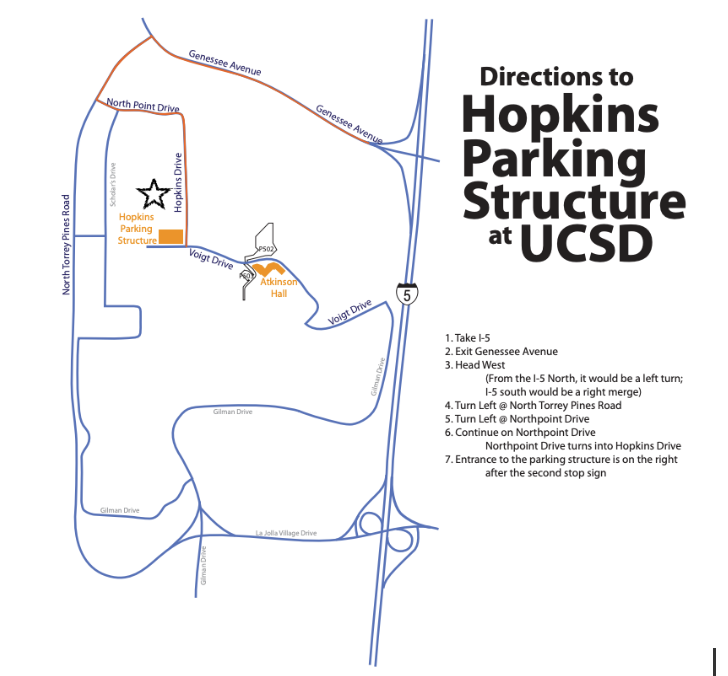
SDSC is located on the UC San Diego Campus in La Jolla. San Diego Supercomputer Center’s Auditorium E-B212 located on the ground floor of SDSC’s east entrance, just off the driveway on Hopkins Dr, close to the Hopkins Parking Structure, Northwest end of UC San Diego campus.
The San Diego International Airport (SAN) is the closest airport to UC San Diego and SDSC.
For driving directions see the SDSC visitor page
Transportation
Visitor parking permits are required to park on UC San Diego campus.
- Visiting UC faculty and staff who hold annual permits at their home campuses are eligible for up to 5 consecutive days of complimentary parking at UC San Diego. See reciprocity details.
- For non-UC visitors, purchase permits at a very reasonable rate — more details.
- The most convenient parking location is the Hopkins parking structure located on Hopkins Dr and Voigt Dr, just south of SDSC.
- Parking legally is the attendee’s responsibility. The penalty for an improperly parked car is at least $65 per day.
For cab or shuttle pick-up/drop-off: 9836 Hopkins Dr, La Jolla, CA 92037
SDSC is located just south of the RIMAC Arena.
Rideshare: Lyft or Uber — use “San Diego Supercomputer Center” as destination.
A taxi or transportation service can be used from the airport:
- SD Taxi Cab Services
- Yellow Cab: (619) 444-4444
- Orange Cab: (619) 223-5555
- SD Taxi Service: (619) 342-6494
- San Diego Cab: (619) 226-8294
- Terramoto Transportation Downtown San Diego — (619) 269-7397
- Torrey Pines Limo — (858) 997-6866
- Super Shuttle — (800) 974-8885
Public Transportation surrounding UC San Diego
Back to all news →