

Material Science • Research
Materials science: revealing the internal evolution of porous materials through large-scale synchrotron imaging
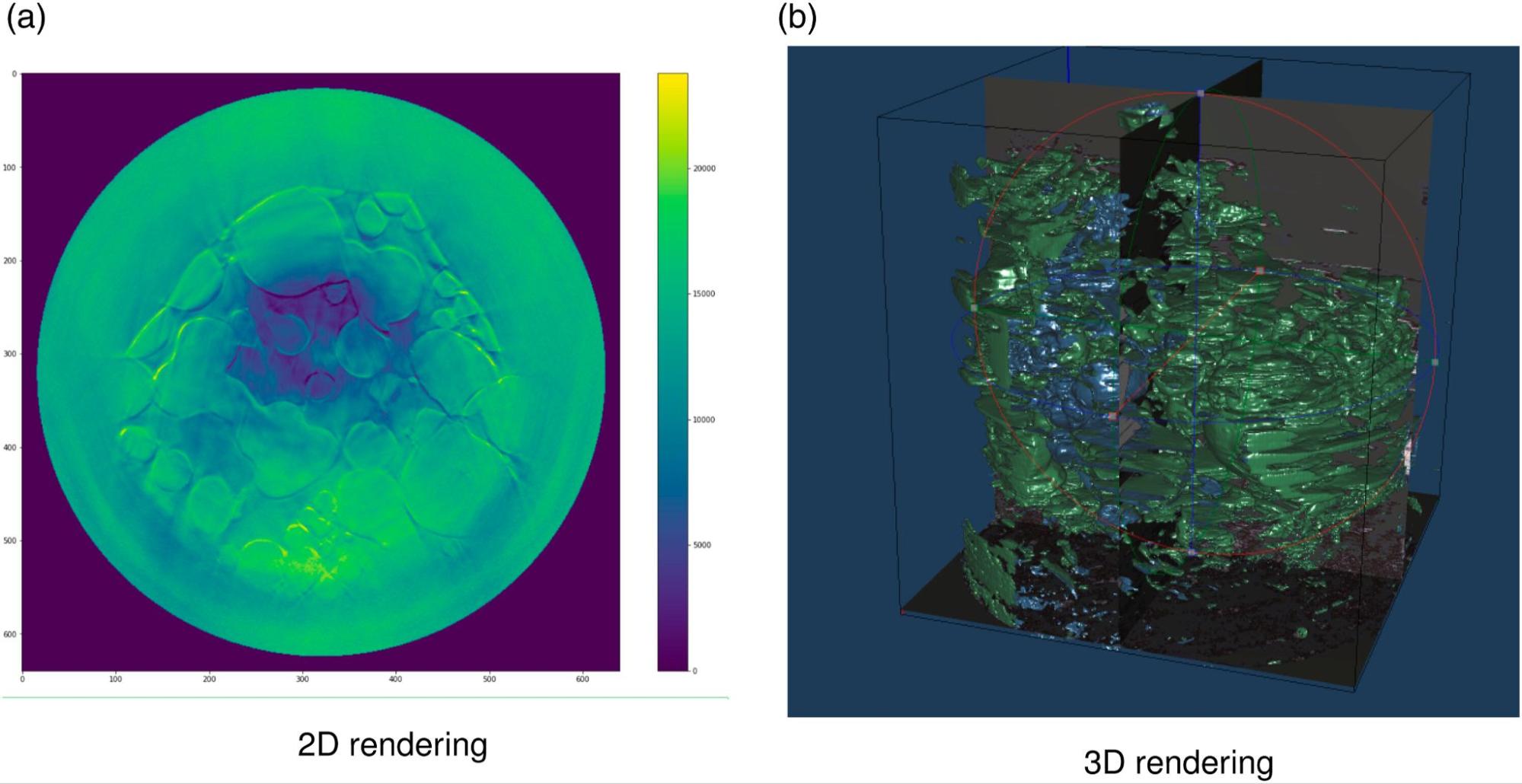
Porous materials are used in applications ranging from lightweight engineering structures and catalysts to biomedical materials. Understanding how they deform and fail, however, requires processing massive synchrotron X-ray tomography datasets. NSDF enables researchers to reconstruct, visualize, and analyze their internal structure at scale, transforming terabytes of experimental images into interactive 2D and 3D views that reveal cracking, pore collapse, and structural evolution.
The Scientific Challenge
Each synchrotron tomography image is approximately 6 GB, and intermediate reconstruction and segmentation stages can generate more than 30 times the original data volume. Processing, storing, and visualizing these data requires large-scale computing and careful preservation of intermediate results so scientists can interpret, reproduce, and trust the analysis.
How NSDF Helps
NSDF orchestrates the complete tomography workflow from image acquisition to analysis. It scales reconstruction and segmentation across CPU and GPU resources, streams analysis-ready data to cloud storage, preserves intermediate workflow products, and provides interactive visualization through Jupyter notebooks. Scientists can focus on understanding material behavior without having to manage the underlying cloud and workflow infrastructure.
Scientific Impact
Researchers can examine how porous materials change under mechanical stress through high-resolution 2D and 3D visualizations of their internal structure. By making large-scale tomography workflows scalable, interactive, and reproducible, NSDF accelerates the analysis of complex materials and supports the design of stronger, lighter, and more reliable engineered materials.
Key Outcomes
- High-Resolution Imaging — Reveals internal pores, cracks, and structural changes through interactive 2D and 3D tomography views.
- Scalable Processing — Handles up to 10 TB of workflow data across heterogeneous CPU and GPU resources.
- Reproducible Workflows — Preserves intermediate data and provenance across reconstruction, segmentation, conversion, storage, and analysis.
- Materials Insight — Helps scientists understand pore collapse, cracking, and ligament buckling to improve future material designs.